Akrotiri Prehistoric City, Santorini: Tickets, Hours, and Highlights
Practical guide to visiting the prehistoric Minoan city of Akrotiri in Santorini, detailing 2026 tickets, hours, and architectural highlights.
Published: September 18, 2024 | Updated: September 27, 2026•By Pavlos Inglesis•12 min read•
GreeceSantorini
The Ancient Akrotiri Prehistoric ruins are one of Greece’s most important archaeological sites and the most significant cultural attraction in Santorini.
This is my video from the Akrotiri Prehistoric City with a ton of information.
This is one of the most important prehistoric settlements of the Aegean that dates back to 4000 BC and flourished till the eruption of the Santorini volcano somewhere between 1650 and 1550 BC. Akrotiri Prehistoric Ruins is a beautiful, excavated, preserved archaeological site that sits very close to the Red Beach of Santorini.
Akrotiri Prehistoric City is considered Greece’s Pompeii, and for many, this was the lost city of Atlantis; make no mistake, this is the top cultural attraction in Santorini and a must-do while on the island.
Akrotiri Prehistoric City Tickets Prices:Full (12€), Reduced (6€) – for Senior EU Citizen over 65 years old and Students outside of the EU, Special Package Ticket (15€ Full) – for 3 days 1 access only to all of Santorini’s archaeological sites including Akrotiri, Ancient Thera and the Museum of Prehistoric Thera
Free Admission to Akrotiri: under 18 years old, EU Students, on the specific dates 28th of October, 6th of March, 18th of April, 18th of May, the last weekend of September every year, and every first Sunday of the month from 1st of November til 31st of March every year
Online Tickets: you don’t have to pre-book your tickets online, and there is barely any lines or queues in the ticket office at the entrance, even in July and August; just show up and pay for the ticket. There is always availability.
Akrotiri Prehistoric City is CLOSED on: 1 January 25 March 1 May Greek Easter Sunday 25 December 26 December
Parking: There is a pretty big free parking lot just opposite the main entrance, so that’s not an issue; expect it to be very busy in July and August, though, so the earlier you visit, the better it will be.
Best Time to go to Akrotiri Prehistoric City: it’s never very crowded and the bioclimatic roof offers very good ventilation so even on the hot summer days it’s very comfortable inside; overall I would suggest it’s better if you visit early in the morning around 9-10 so that you can continue your day to a nearby beach (Red Beach is in walkable distance)
How to Get to Akrotiri: The “Akrotiri Bus” from Fira will take you there in about 20 minutes (check the Santorini buses)
The best thing to bring with you on your visit to Akrotiri isa bottle of water! There are a few vending machines in the area and some small kiosks selling snacks and drinks, but you had better bring your water; you will need it in the summer.
Where to Eat after your Akrotiri visit:There are only a few options just down the small beach from Akrotiri: Melina’s Tavern, Cave of Stolidas and Cave of Nikolas restaurants, with Melina’s being my personal favourite (they are all good!).
AKROTIRI SANTORINI PREHISTORIC CITY ENTRANCE AND TICKETS
It’s very easy to go to the Akrotiri Prehistoric City Archaeological Site. There is a direct local bus from Fira (20 minutes’ drive), but you can also take a taxi or drive your car.
The parking lot just outside of the Akrotiri Prehistoric City Entrance, which is also where the local Santorini Bus will drop you off.This is the main entrance of the Archaeological Site (yes, stray dogs and cats will be around, and they are very well treated and taken care of by the Museum staff).This is the ticket office of the Akrotiri Prehistoric City Archaeological Site; there are barely any queues even in the busiest of times in July or August, so it’s not necessary to book anything online in advance. You can find the latest details for the tickets and the opening hours just posted on the ticket office itself, so please check before buying any tickets to see how many you need (children and Seniors over 65 go for free, for example).The outdoor area of the Archaeological Site is well-maintained with plenty of space and dedicated paths.There is even a vending machine with drinks and cold water, but I highly advise having your drinks and water as I cannot guarantee these will work when you visit. There is even a local WiFi that you can use around the area.There are many available toilets and amenities on the site, and they are all very clean and accessible.This is the main entrance of the archaeological site itself.Some super (and not prehistoric) dogs are around, and the museum’s staff takes care of them.
THE HISTORY OF THE EXCAVATIONS IN AKROTIRI
Archaeological excavations in Akrotiri started in 1867 when some locals found some artefacts. The main excavation, though, was initiated by the visionary Greek Archaeologist Spyridon Marinatos (who died in 1974) and his assistant Christos Doumas, who is still the main Lead Archaeologist in the ongoing Akrotiri excavations.
Photo from the main Akrotiri excavations in 1967-1974 (yes, these were found during the military Junta in Greece; Spyridon Marinatos was a supporter of the regime).Spyridon Marinatos in 1971 posing with his camera on top of the freshly excavated ruins of prehistoric Akrotiri (Photo: S. Meletzis).Christos Doumas (on the left and Marinatos on the right) took over the responsibility of Director of Akrotiri Excavation until today. He is currently the single most knowledgeable person about Akrotiri on earth. Here is a great mini-documentary (in Greek) about him. A map showing exactly how the area looked back in the day is available on the site.
INSIDE THE AKROTIRI SANTORINI PREHISTORIC CITY ARCHAEOLOGICAL SITE
The main archaeological site in Akrotiri is covered in an impressive bioclimatic roof that has recently transformed the whole area. The new roof was installed and has been in operation since 2012. It was built to replace an old and rusty roof that was originally installed in the 70’s.
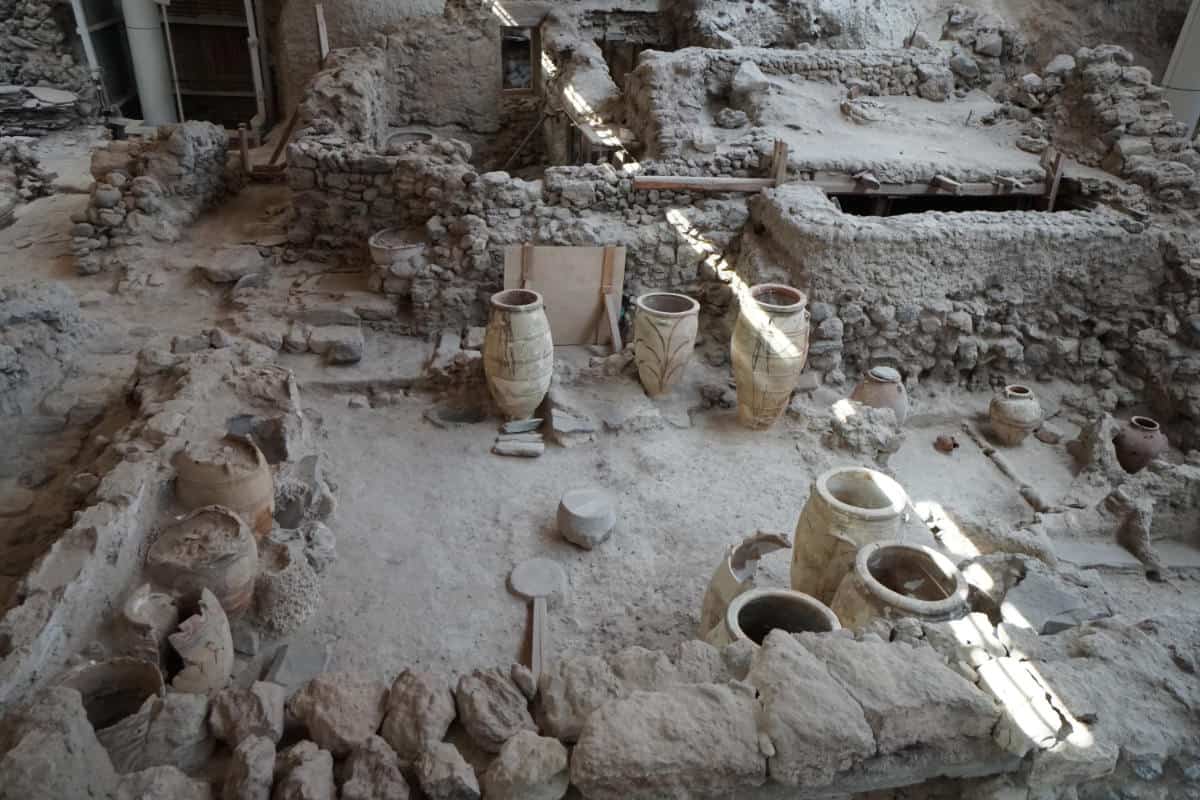
The archaeological site is one of the most impressive in Greece, with wide wooden dedicated pathways and a massive bioclimatic roof.Once you get in, you will see lots of groups from guided tours, and I highly recommend you get on one guided tour, such as this one.There is also a miniature model that shows a complete overview of what the whole excavation site looks like. There are also many pictures showing the history and progress of the excavations in Akrotiri.This is the Akrotiri Excavations Lab, where restorators work daily to collect, categorize, and store all the artefacts and pieces of prehistoric ruins found on-site during the excavations. The dedicated path for the visitors is wooden and very smoothThe findings are impressive, as this is a small city that flourished, and it was one of the richest in the Mediterranean Sea back in the day (1600 BC).There are many rooms in the town’s buildings; most were rebuilt after several earthquakes and volcanic eruptions.The Akrotiri prehistoric city is believed to have had at least 30,000 people, and it had an excellent urban design, storage buildings, a complete drainage system, and paved roads and streets. The main building materials were stone, clay, hay, wood, and gypsumThere were two and 3-storey buildings decorated with impressive colourful frescoes, showing this was an elegant society fully appreciating art and luxury. The most interesting fact is that no human remains were ever found in the excavation which led the Archaeologists to believe there was a catastrophic event that made people get on the nearest ship and abandon their city; this event was believed to be one of the biggest volcanic eruptions ever happened in human history, that occurred in Santorini around 1500 BC.Everything was pretty much covered in volcanic ashes, and the archaeologists had to invent new methods to make sure the findings were not damaged. There are lots of clay pots that were mostly used for the storage of flour, oil, olives, weeds, and other edibles. There were lots of storage rooms because Akrotiri was flourishing, and it was one of the largest ports in the area at the time.You will be getting very close to all the artefacts and findings, but you won’t be able to touch or get very close to them as they are extremely sensitive.The city itself had lots of squares and impressive roads.The House of Ladies is one of the less stable at the moment, and it is the one where some of the most impressive frescoes of the excavation depict women’s life in the Minoan culture and society. The excavation is ongoing, and you may see people working on some of the rooms when you visit.You will see lots of supporting beams, as most of the buildings are very unstable and the slopes need additional support.The city’s buildings are still impressive, as we are basically talking about a city that flourished 1500 years before the Roman Empire, for example. These are some of the oldest buildings in the world.These are believed to be prehistoric beds and furniture.
THE AKROTIRI PREHISTORIC CITY SHOP
The Akrotiri Prehistoric City site has a small but lovely shop selling books and copies of some of the artefacts in Akrotiri.
The Museum Shop in Akrotiri is small but interesting.The shop is open at the same opening hours as the archaeological sites. The shop sells copies of some artefacts.There are some impressive copies that you can buy.The shop also sells books about the excavation in Akrotiri.Some of the copies are extremely detailed.As you leave the Akrotiri Prehistoric Site, you will see a small kiosk selling books and souvenirs. This is set up by the people who are actively working in the excavations and are supporting them and their work directly (yes, the Greek State is not funding the excavations enough, and it is a fact that these people working there are paid peanuts, so please support these teams as much as possible). The kiosk is run directly by the excavation workers. The museum shop and the archaeological site are run by the Greek Ministry of Culture.
NEARBY RESTAURANTS AND CRUISES FROM AKROTIRI
A small beach is a few meters down the road as you exit the Akrotiri Archaeological site.There is a small port from where you can get a boat to other islands and some of the main beaches of Santorini. Directions from Akrotiri are clear…You can get a small cruise boat to these areas from Akrotiri.Just outside the ticket office, you will find all the details about the available tickets and the opening times.The small beach with a few fish restaurants just meters away from the Akrotiri. Prehistoric CityMelina’s Tavern is one of the best restaurants in Akrotiri.
FAQs
Do I need to book Akrotiri tickets in advance?
No. Unlike the Acropolis in Athens, you do not need to pre-book your tickets online for Akrotiri. You can purchase your tickets directly at the entrance ticket office upon arrival. Even during peak season in July and August, the queues are minimal and there is always availability.
How much does it cost to visit Akrotiri in Santorini?
A standard adult ticket costs €12. Reduced tickets are available for €6 for senior EU citizens (over 65) and non-EU students. Admission is free for anyone under 18 years old and EU students with a valid ID.
How long does it take to walk through Akrotiri?
You should plan to spend 1.5 to 2 hours exploring the Akrotiri archaeological site. Because the entire site is covered by a bioclimatic roof, it is well-ventilated and shaded, making it a comfortable walking experience even during the hottest hours of the day.
Is Akrotiri the lost city of Atlantis?
Many historians and archaeologists believe that the catastrophic volcanic eruption that destroyed and buried the advanced Minoan settlement of Akrotiri around 1600 BC may have inspired Plato’s legend of the lost city of Atlantis.
HE
Partner pick for this guide
Skip the line
Skip the queue at the Acropolis and beyond
Headout sells timed-entry tickets and guided visits for Athens and the islands, with instant mobile delivery.
Hi, I’m Renato Jordan Leite, I took my wife and son to Akrotiri in Dec 2007. It was no possible to visit the site, since the old structure from the 70’s was in place and it was forbidden the presence of visitors. As a an avid archeologist lover, geologist by formation, I had to see the site. I found my way to the site and got close enough to peep through the structure. I took a picture of the city. Immediately, some archeology student lady in the headquarter in place yelled “police”, and pointed at me, releasing the two dogs. I believe two more people were also there, but stayed behind. Fortunately I did not get hurt, I raised my hands, showed my camera, and approached her, dogs were around but it was OK, I explained to her I was a geologist with a passion, but it looks she could barely understand english. She guided me to the metal gate, I went back to my wife and son and then we visited the nearby beach. No restaurants in the area at that time. Went back to the city, had wine and olives and a wonderful meal, with an interesting adventure to tell about Akrotiri. Today I discovered the site was rebuilt as a touristic place in 2012. I would like to make a donation to the archeologists team, hopefully the ones that were present during my “unfortunate” contact with them, please let me know if you have an account for donation. If not, one day I will be back, will tell my story again, and place a donation in person. I wish all the best to the archeologists team, you are in my heart, and your achievement was great, intangible!!